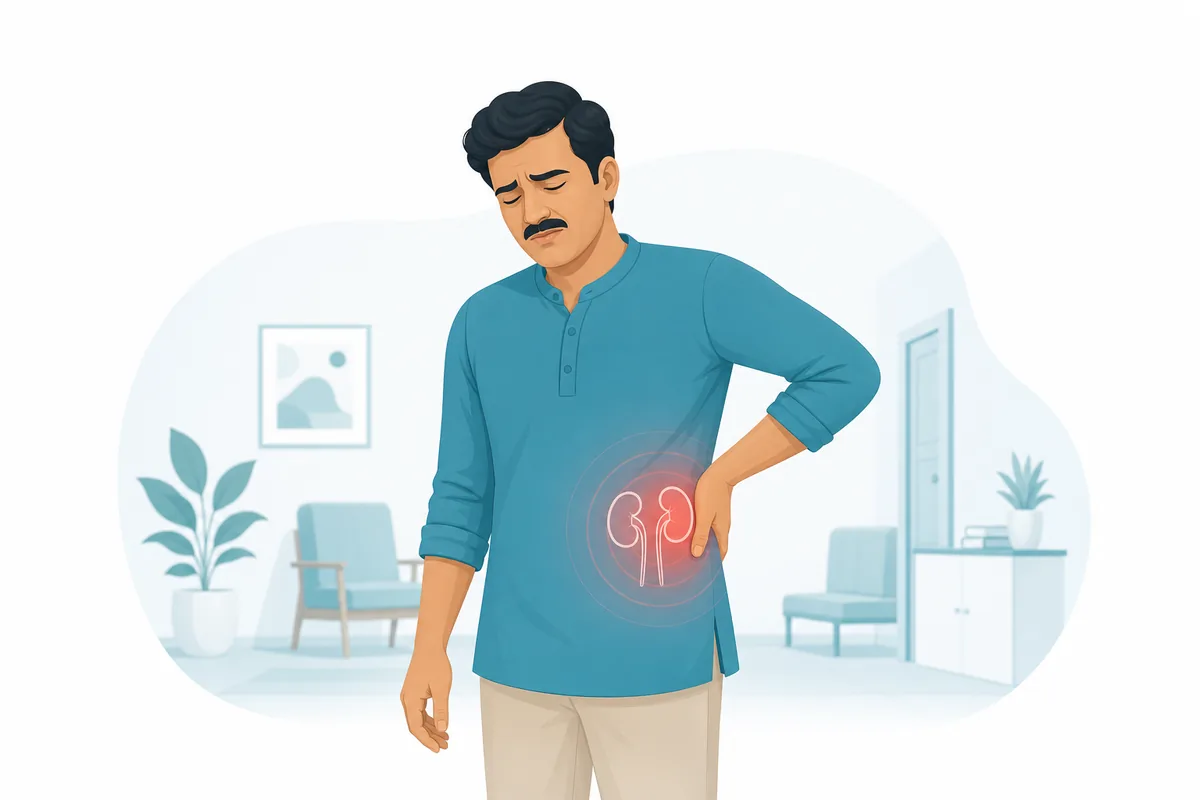

If you are up at an odd hour with your stomach cramping, running to the toilet and maybe throwing up, you want three answers fast: is this dangerous, what do I take to stop it, and when do I need to see a doctor. After 30 years of seeing this almost every summer in my Gurgaon clinic, let me give you the honest version, in plain language.
The short version, if you read nothing else
Most loose motion and vomiting is just your body clearing out something that did not sit well with it. If you are otherwise well, it settles on its own in a day or two. The most useful thing you can do is replace the fluid you are losing. The most harmful, and I see it every week, is starting an antibiotic on your own.
First, the names people mix up. They are mostly the same illness in different clothes:
So do not worry too much about which name it is. What matters is how you feel. Most people will have none of the warning signs below, and can safely look after themselves at home.
See a doctor the same day, or go to a hospital, if:
 Can't keep fluids down
Even small sips come straight back up, or there is little urine, a dry mouth and dizziness, what doctors call dehydration.
Can't keep fluids down
Even small sips come straight back up, or there is little urine, a dry mouth and dizziness, what doctors call dehydration.
 Blood, or severe pain
Blood in the stool, or a stomach pain that is severe and constant rather than coming and going.
Blood, or severe pain
Blood in the stool, or a stomach pain that is severe and constant rather than coming and going.
 High fever
A high fever, especially with shaking chills.
High fever
A high fever, especially with shaking chills.
 Not settling
Still going strong after two to three days, or getting worse through the day instead of slowly better.
Not settling
Still going strong after two to three days, or getting worse through the day instead of slowly better.
If none of those apply, take a breath. It helps to understand what your body is doing.
What is actually happening inside you
When your gut meets a toxin in spoiled food, it flushes it straight back out. The vomiting empties the stomach. The loose motion rushes everything through before your body can absorb it. It feels awful, but most of the time your body is protecting you. Think of it as your gut hitting an emergency flush: better to lose some water than let the toxins sit and soak in.

Vomiting and loose motion are the body flushing the bad stuff out before it can be absorbed.
This is why most of these episodes are self-limiting: left alone, with enough fluid, they settle by themselves. It is also why the first thing most people reach for can backfire.
"Which tablet will stop it fast?" The question everyone asks me
When the loose motion starts, the instinct is to shut it off at once. I understand it, but let me be honest about where it goes wrong. Every week I see people taking a "stop-it" pill, an anti-diarrhoeal like loperamide (Roko), two or three times a day for days. It slows the trips to the toilet, but only while the medicine is working, and it does nothing about the cause. Worse, holding everything in can keep the toxins your body is trying to flush out trapped inside, which sometimes makes you more sick. So treat them as a one-time SOS to reach a doctor, not a course you run on your own without supervision.
The bigger mistake usually comes next: reaching for antibiotics on your own. What I tell those patients is this.
"An antibiotic is needed only for a bacterial infection, and it is not the chemist's job, or yours, to decide whether it is bacterial. If the loose motion is viral, or it is acidity, or an irritable bowel, the antibiotic will not help. It is simply wasted, and it puts you at a real risk."
That risk is antibiotic resistance. Every time you take an antibiotic you did not need, the toughest bacteria survive and multiply, so the next time you truly need it, the medicine may not work. Doctors already see infections that resist almost everything, and India is hit especially hard, because antibiotics here are sold across the chemist's counter without a prescription. That is exactly why the decision to use one belongs to a doctor, not the chemist.
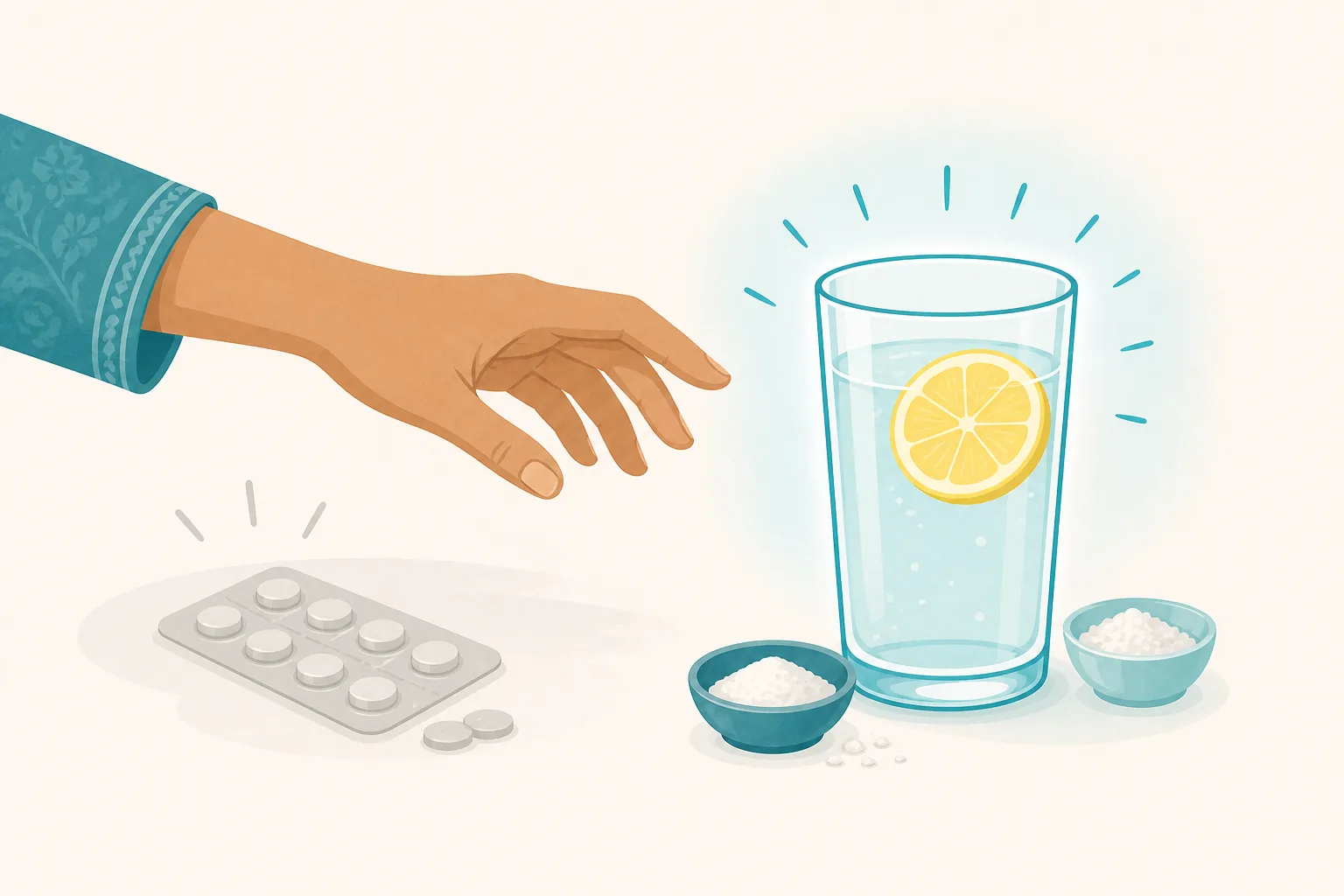
In the first hours, replacing fluids matters far more than any tablet.
Still, you are not helpless at 2 a.m. with no doctor nearby. The first few hours are about staying safe, not curing yourself. For an adult, here is what is reasonable to keep at home and take once, just to get through until a doctor can see you. (For a child, the only home step is ORS, then a doctor.)
Every tablet above is a single dose to reach morning safely, not a course of treatment. Fluids are the exception: keep sipping them throughout. What actually fixes this depends on the cause and your other health problems, and that is a doctor's job, even over a video call. Which raises the question I hear most: when has "wait and watch" run out?
When it is serious: the line I want you to watch
My rule is simple. If you are otherwise healthy, the symptoms are mild, and you are improving through the day, ride it out at home for a day or two with fluids and rest. Most people are clearly better by day three. See a doctor the moment that stops being true. See one if you are not improving, or getting worse. And see one early for anyone higher-risk: a small child, someone elderly, or a person with diabetes or another ongoing illness.
And there is one more reason to come in when things are not settling after two or three days: not every stomach pain is food poisoning. I once saw a patient with fever, a few loose motions and some vomiting after eating out. It looked like a clear stomach infection, so I started treatment, but the pain would not settle. When I examined the abdomen again, it was an inflamed appendix, not a gut infection at all.
"Every stomach ache cannot be food poisoning. It can be the appendix, the gallbladder, the pancreas, even a stone. I never write a medicine without examining the abdomen. If the pain is not getting better, you need to come in and let me check."
That is the danger of medicating blindly: a tablet quietens the symptom while something serious is missed. So treat the warning signs as reasons to be examined, not medicated away: blood in the stool, a fever that will not come down, pain that is severe or constant, or signs of dehydration. A doctor needs to examine you, because the cause may be an infection or something else entirely, and only an examination can tell. Do not try to settle these at home.
What I want you to drink and eat
Fluids are the real treatment, so get them right. The aim: put back the water and salts you are losing. Plain water is not enough, because what you lose is electrolytes, the salts that keep your body running. That is the point of an ORS, a drink of salt and sugar mixed into water: the sugar gives you energy and the salts help your body hold on to that water, so you actually stay hydrated. People ask me about juice. But juice is really just water and sugar; it does not give back the salts you lose, like sodium and potassium, and without those salts the water runs straight through you. So reach for the right things:
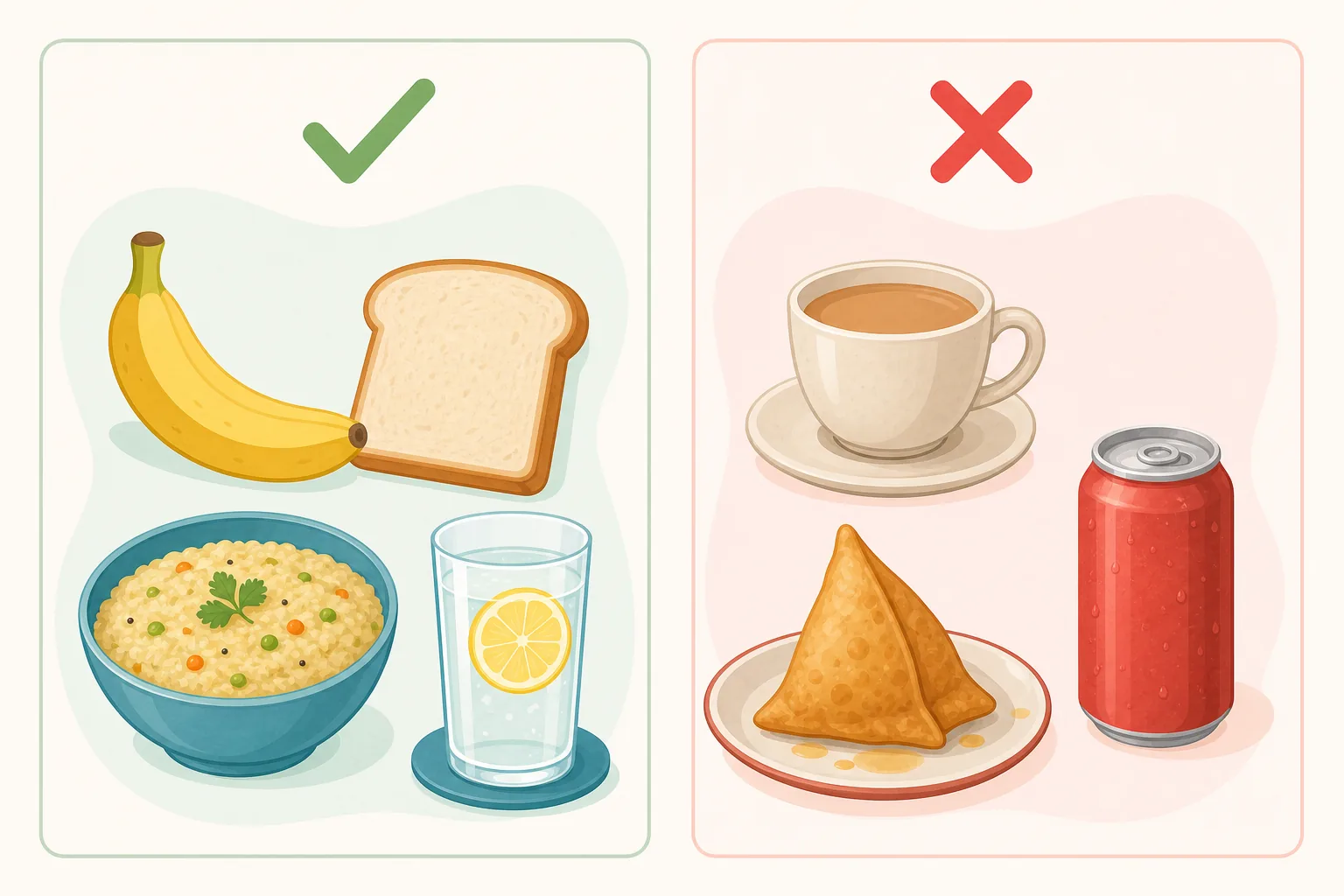
Easy to digest on the left; the things that make it worse on the right.
How you take ORS matters too. Gulp a full glass while you feel sick and it comes right back up. So sip slowly, a little at a time, and take more as your stomach settles. A simple rule: after each loose motion, drink back roughly what you lost.
Two cautions. If you have diabetes or high blood pressure, go easy on added salt and sugar and lean on plain ORS. And coconut water is high in potassium, so if you have a kidney problem, check with a doctor first. Children, as always, are a different story.
When it is your child
Children are not just small adults. They lose water far faster for their size, so they can become dehydrated quickly. That thin margin is why, for small children, I would rather a paediatrician took the lead. What every parent should watch for is simple:

Children dehydrate fast: give ORS in sips, and watch for a child who stops passing urine.
The first move is the same as for you: ORS, sip by sip. For children, the standard treatment also includes a course of zinc (about 14 days), which your paediatrician will guide. I know how hard it is to watch a child in pain at an odd hour with the doctor out of reach. If you must give something, keep it to a single small dose suited to their age and weight, as a bridge until you reach the doctor: an anti-vomiting medicine if nothing will stay down, a gentle anti-diarrhoeal, or an antispasmodic for a gripping cramp. Never repeat it blindly, and treat it as a way to reach help, not a reason to stay home. An antibiotic for a child is always a doctor's call.
If a child is not passing urine, is drowsy, cannot keep fluids down, or there is blood or a high fever, do not wait at home and do not reach for medicine. Take them straight to a doctor.
Why it happened: bacteria, a virus, or even a medicine
Once the worst passes, people want to know what caused it, and the answer changes what helps. This is how I sort most cases:
This is why "I will just take the antibiotic" so often misses: if it is viral, acidity, or an irritable bowel, it does nothing. Telling them apart is what a doctor is for: your symptoms, an examination, and sometimes a stool or blood test when things are severe or not settling. Usually it does not come to that, because the illness runs its course.
How long it lasts, and getting your strength back
A normal stomach bug usually runs its course in about five days, and many feel clearly better within two or three. When a bacterial infection genuinely needs an antibiotic, I prescribe a full course, usually at least five days. The one instruction that matters most: finish it, even after you feel fine.
Recovery does not end the moment the toilet trips stop. Feeling weak for a little while afterwards is normal, especially if you could not eat or drink much; your strength returns as you rehydrate and eat properly. Most people recover at home on fluids like ORS and nimbu paani and, if needed, the right oral medicine. A drip is not needed for a mild illness. The exception is severe dehydration, when you cannot keep anything down. Then fluids must go in through a vein, and occasionally a short hospital stay is needed. It is uncommon, which is exactly why the warning signs at the top are worth knowing, and worth preventing.
How to keep it from happening again
Most of this you can avoid. In Gurgaon it is mainly a summer problem, because the heat lets bacteria multiply in food left standing. The example I repeat most is the one nobody suspects: ice cream.
"People swear they ate nothing outside. Then they remember the ice cream. And ice cream is frozen, so bacteria should not be able to grow in it. But think how often the power goes in Gurgaon. It melts, the toxins set in, then the power returns and it freezes solid again. You buy it, store it in your freezer, and eat it frozen, never knowing it had already spoiled somewhere in between."
That story holds the whole principle: bacteria grow when food sits at the wrong temperature, and they travel in unclean water. So here is what I tell families to watch, especially in summer:

In the summer heat, these are the usual culprits behind a stomach infection in Gurgaon.
And if you catch this again and again? A lot of it is plain immunity: one family shares a meal, and one person is barely troubled while another is badly hit. Getting it once does not make you immune for life, so the same habit brings it back. But if it genuinely keeps happening, see a doctor to investigate. A gut that is upset over and over can point to something underneath, from low immunity to a medication side effect.
When to see a doctor
Most loose motion and vomiting settles at home with patience and the right fluids, and now you know how to give your body that chance. But you do not have to read the worrying signs alone. See a doctor if it is not improving in a day or two. See one for a child, an elderly person, or a diabetic family member. And see one if there is blood, a high fever, or a pain that will not ease. A doctor can examine you and treat the cause, not just the symptom.
Written by Dr. Deepika Kaushik
General physician, Dr. Deepika's Complete Family Clinic, South City 2, Gurgaon.
A note: This page is general information to help you understand loose motion, vomiting and stomach pain. It is not medical advice for your particular case. Please follow the advice your own doctor gives you. If your symptoms change or get worse, or you are worried, contact Dr. Deepika's Complete Family Clinic. Last reviewed by Dr. Deepika Kaushik.
Sources
This article is for general education and does not replace seeing a doctor. It is grounded in major international and Indian guidelines and published studies, including:
- World Health Organization: factsheet on diarrhoeal disease, oral rehydration and prevention.
- American College of Gastroenterology (2016) and the Infectious Diseases Society of America (2017): clinical guidelines on managing acute diarrhoea and when antibiotics are, and are not, needed.
- Indian Council of Medical Research: treatment guidelines on antibiotic use, and its national antimicrobial-resistance surveillance.
- A 2021 Indian study on antibiotics being sold over the counter without a prescription (journal Antibiotics).
- NICE and the NHS (UK): guidance on gastroenteritis in children, oral rehydration, and the cautions on anti-diarrhoeal medicine.
- Indian Academy of Pediatrics: guidelines on managing acute diarrhoea in children, including ORS and zinc.
- Cochrane review (2006): oral rehydration works as well as a drip for most children.
- US CDC and MedlinePlus: patient guides on norovirus (the "stomach flu"), food-poisoning prevention, and medicine-related diarrhoea.