
Dengue season in Gurgaon runs July to November. If someone at home has a sudden high fever and body aches bad enough that they can barely walk, read this before you do anything else.
Dengue in Gurgaon — the part most people don't know
If you live in Gurgaon and you've never had dengue, you might be the unusual one in your building. Studies estimate that more than 60% of adults in North India have already been infected, often without realising it. The official case numbers are largely underreported each year; researchers estimate the real burden is roughly 280 times what gets recorded.
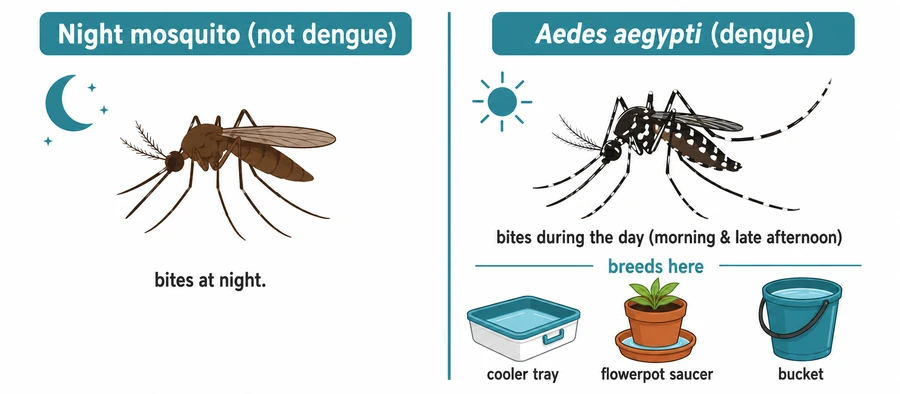
Part of why it spreads so easily here is the mosquito itself. The dengue mosquito, Aedes aegypti, doesn't breed in drains or open water bodies. It breeds in small, clean, stagnant water: the tray under your cooler, a flowerpot saucer, a bucket left on the terrace after rain. And unlike the mosquitoes that bother you at night, this one bites during the day. Peak hours are early morning and late afternoon.
If you're reading this in August, this is not hypothetical.
What dengue actually is
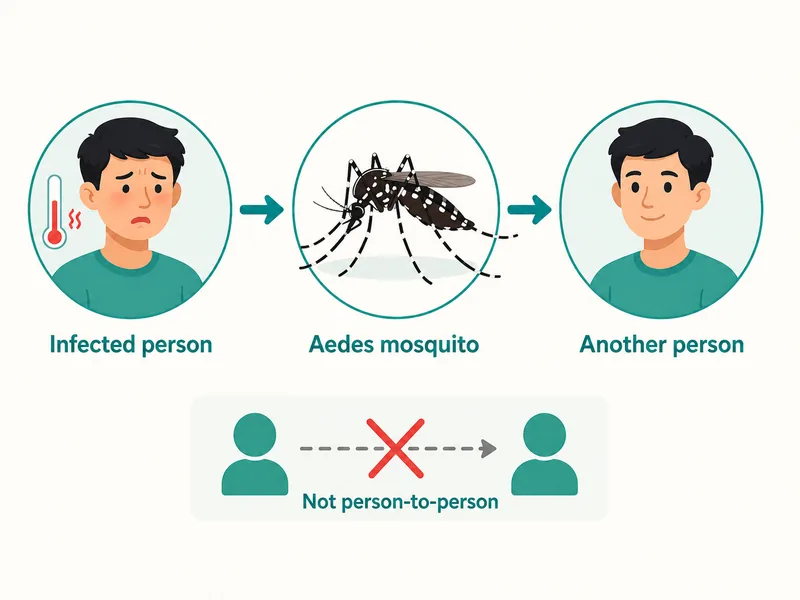
Dengue is a virus transmitted only through the bite of an infected mosquito. You cannot catch it from another person. It does not spread through touch, air, or shared food. After the bite, the virus takes four to seven days to show symptoms. Most people go through it with fever, aches, and fatigue, and recover without complications.
In roughly five out of a hundred patients, something more serious develops. Think of blood vessels like water pipes. Dengue can make those pipes leaky: fluid moves out of the bloodstream into surrounding tissue. Platelets, the cells that help stop bleeding, may also fall. This is what doctors call severe dengue, and it's why dengue needs monitoring beyond just checking the temperature.
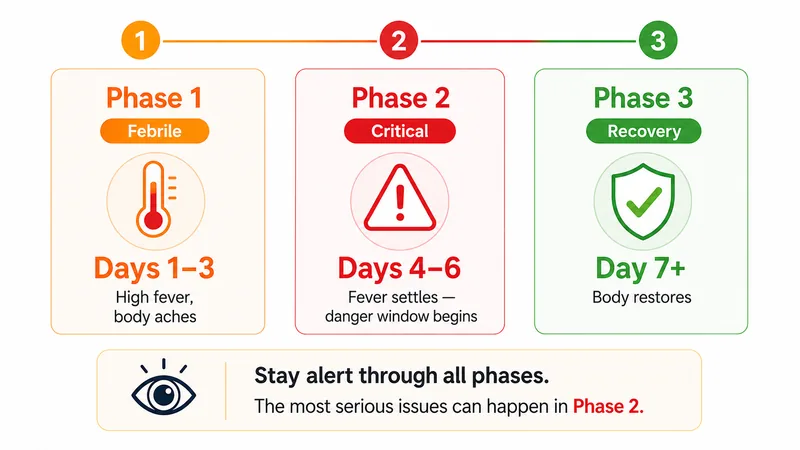
The illness has three phases, and knowing them will help you understand why dengue is managed the way it is:
The critical phase is the part most patients don't know about. We'll come back to it.
First signs — and how to tell it apart from "just a viral"
Most fevers in Gurgaon are not dengue. But in the first 3–4 days, dengue has a recognisable pattern. A simple viral fever comes with cough, cold, and sore throat from day one. Dengue is different.
"There's a sudden high-grade fever, severe body ache and joint pain, a headache, sometimes a mild cough — but not the runny nose you'd expect with a cold."
That sudden onset with intense body pain is the flag.
Typhoid presents differently: the fever rises gradually, not suddenly, and usually comes with more abdominal symptoms. Malaria tends to come with chills and shivering in a cyclical pattern. A urine infection can also cause fever with shivering.
"Two patients in the same week, same symptoms — high-grade fever, nothing else — one turned out to be typhoid, one dengue. You cannot diagnose this reliably from symptoms alone."
When dengue is suspected and there's no clear source of infection, the standard first workup is all at once: CBC, CRP, dengue NS1 antigen, Typhidot, and urine routine. One visit is rarely enough: dengue parameters shift day to day, and the doctor will schedule repeat tests at regular intervals even when the patient seems fine. The family's job is to keep a close watch and not miss follow-ups. For households with a dengue patient: dengue does not spread person to person. The mosquito is the link, not the patient.
The dangerous window: days 4–6
If there is one sentence in this post worth remembering, it's this: the most dangerous days of dengue are usually days four to six, often after the fever has already settled. The patient who feels relieved when the fever drops, and stops watching, is the patient doctors worry about.
Dr. Deepika describes the case that stands out from last season:
"There was a patient who was doing well for four days. She said she was fine. But she mentioned breathlessness. I got an X-ray and abdominal ultrasound done. The results showed fluid in the lungs and fluid in the abdomen — both signs of plasma leakage — even though her blood parameters weren't dramatically abnormal yet. I told her immediately: you need to go to the hospital. She was reluctant. 'I'm fine, why are you referring me?' I had to insist. She was admitted."
This is what makes dengue different from most other fevers.
"In typhoid, we know what to expect. In a urine infection, we know. In pneumonia, we know. But dengue is unpredictable. They're fine today — what will happen tomorrow, we cannot say."
Dr. Deepika tells every dengue patient from the first visit: the fever will last around five to six days, but monitoring is not over when it settles. "Don't consider it a complete recovery until one week post-fever has passed comfortably."
These signs need medical attention today — don't wait:
That last one is the most commonly missed. The fever going away is not recovery. It is the beginning of the critical window.
Why the second time can be worse
Patients sometimes say: "I had dengue once, so I'm not too worried." Having had dengue once does not mean the next infection is milder.
"It's possible to get dengue a second time. You might get a milder illness — but a second infection is always considered potentially more dangerous, not less. Dengue has four strains. Getting immunity from one strain doesn't protect you from the other three. And sometimes that old immunity triggers the immune system in a way that makes the new infection more severe."
If you've had dengue before and develop a fever during dengue season, get medical attention at least as promptly as someone who has never had it. Complications are most common in those with a previous dengue infection, older patients with diabetes or heart disease, and very young children.
Tests — what to ask for, and when
The first dengue test you ask for matters less than when you ask for it.
"I occasionally wait two or three days before ordering the NS1 — so I can see the NS1 result and the CBC change together in one visit, and the patient doesn't need too many blood draws."
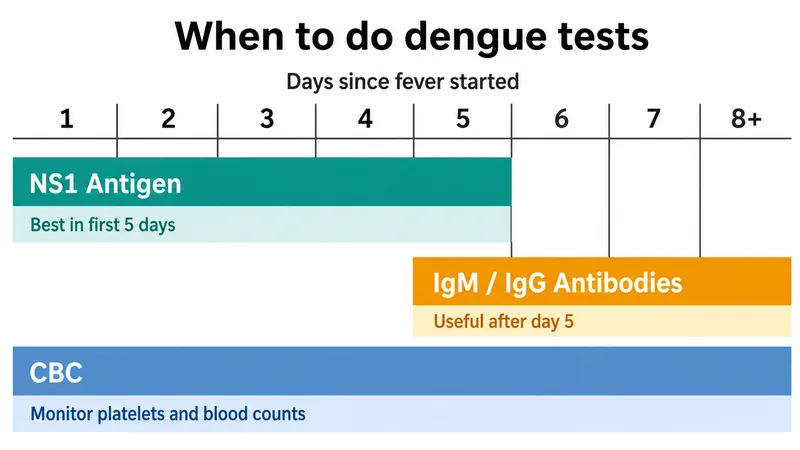
If the NS1 is negative but symptoms continue and dengue is still strongly suspected, antibody testing follows. If both are negative but the clinical picture still points to dengue, a PCR test can be done.
One more thing: going to the lab without a doctor's prescription often means getting the wrong test at the wrong time. The doctor decides which test to order, and when.
The platelet thing — the most misunderstood part of dengue
Every dengue season, the same calls come in: "the platelet count is 80,000, what do we do?" In almost every case, the answer is: don't panic, and almost certainly not a transfusion.
"Platelets go low in dengue because of the virus. As soon as the virus's effect is over — as the patient starts recovering — the platelets rise on their own. There is no medicine to increase them. That's not how it works."
But platelets are only part of what we monitor. The complete blood count — haematocrit, haemoglobin, and platelets together — is what matters. A rising haematocrit, even with a normal platelet count, is an early sign that dengue is causing plasma to leak out of the bloodstream. This is the parameter that can catch a serious complication before the platelet count has even moved.
What matters more than the number: is it still falling? Are there signs of bleeding? Are the vitals stable? Families who push for transfusion at 80,000 are asking for an intervention that won't help and carries its own risks.
On papaya leaf, giloy, and kiwi fruit:
"For whomever the platelets are going to recover — they'll recover whether you give papaya leaf or not. And for whomever they're going to continue falling — they'll fall even while taking it. If you make them drink something that doesn't taste good, they may vomit, their stomach may get upset — and you've made the dehydration problem worse."
If you're being properly monitored and want to try it alongside that monitoring, that's your choice. But papaya leaf is not a substitute for daily CBC monitoring, and it does not treat dengue.
What to do at home — and what not to do
The dengue errors are almost all about what not to do.
The single most important rule: until a doctor confirms the diagnosis, take only paracetamol. Nothing else for fever or pain.
"Dengue causes severe body aches — sometimes so severe patients can't walk. So they take a Combiflam or a Voveran or a Nise on their own. These are from the NSAID group or contain aspirin. They reduce platelet aggregation and increase the tendency for bleeding. Patients come to us having already made this mistake. When they do, I tell them: no matter how much pain you have, I will not give you a painkiller. Tolerate it. We'll manage the fever with paracetamol."
Medications to avoid until a doctor sees you: Combiflam, Sumo, Nise, Voveran, Brufen, Disprin — and any other NSAID or aspirin-based painkiller. Use only paracetamol until a doctor has seen you.
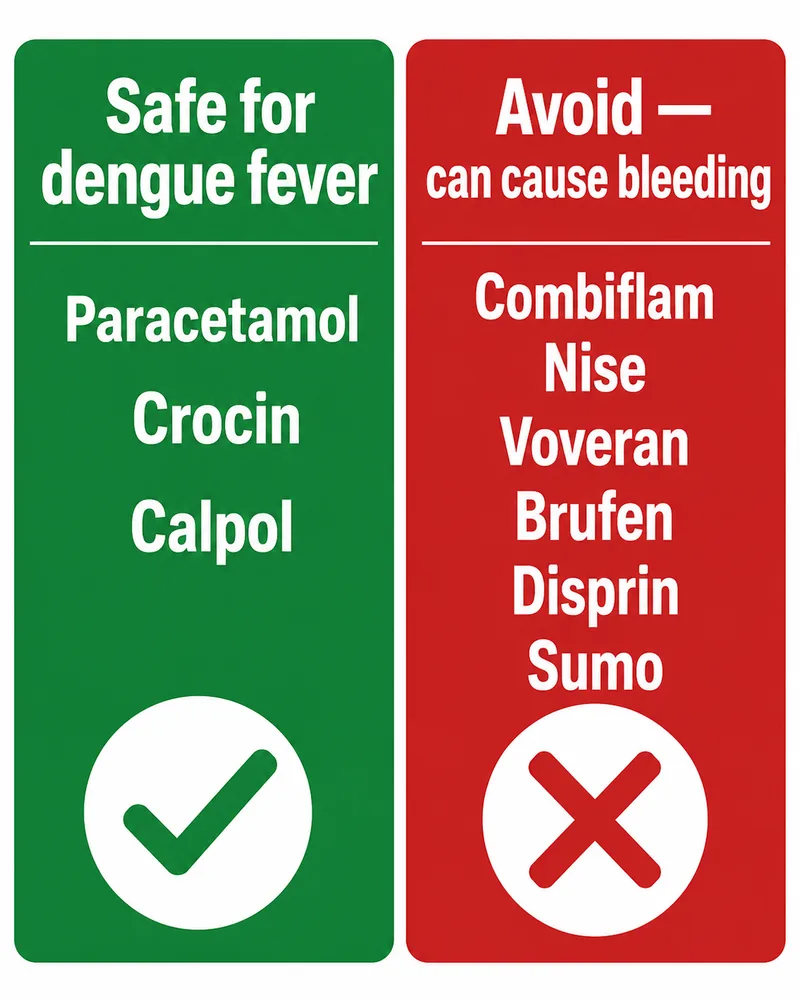
Also: no antibiotics from the chemist. Dengue is a virus. Antibiotics don't treat it.
What to do:
- Paracetamol every six to eight hours for fever
- Plenty of fluids: water, ORS, coconut water, fresh juice
- Rest
- Watch urine colour and frequency — dark urine or much less urine than usual signals dehydration
- Keep all follow-up appointments, especially in the day four to day six window
When to come to the clinic — and when to go straight to hospital
Come to the clinic the same day (within hours, not next week):
- Fever for more than three days, no diagnosis yet
- Persistent vomiting, can't keep fluids down
- Severe body aches with high-grade fever
- Fever has just settled and the patient feels worse, not better
- Someone in the household has been diagnosed with dengue
Go straight to hospital emergency — don't wait:
- Any bleeding: gums, nose, skin spots, blood in vomit or stool
- Severe abdominal pain
- Rapid breathing or breathlessness
- Cold hands and feet with a fast pulse
- Severely dehydrated: not eating or drinking for multiple days
- Confusion, restlessness, sudden weakness
- Blood parameters showing rapidly falling platelets, rising haematocrit, or dropping blood pressure
Not sure which category this is? Call the clinic. Our number is at the top of your prescription.
Stopping it before it starts — the Gurgaon mosquito playbook
RWA fogging is easy to arrange. The dengue mosquito doesn't breed where fogging reaches. It breeds in a flowerpot saucer inside your building.
Aedes aegypti is a short-range mosquito. It breeds in clean, stagnant water in small containers — coolers, terrace tanks, flowerpot saucers, AC drip trays, old tyres, any construction-site puddle you can see from your balcony. It bites during the day.
"If one person in the house gets dengue, that means there is an Aedes mosquito in your house. It will bite the dengue patient, take the virus, and transmit it to the next person. The colony is nearby — inside the house. So decontaminate your entire house with insecticide spray and keep the doors closed during the day."
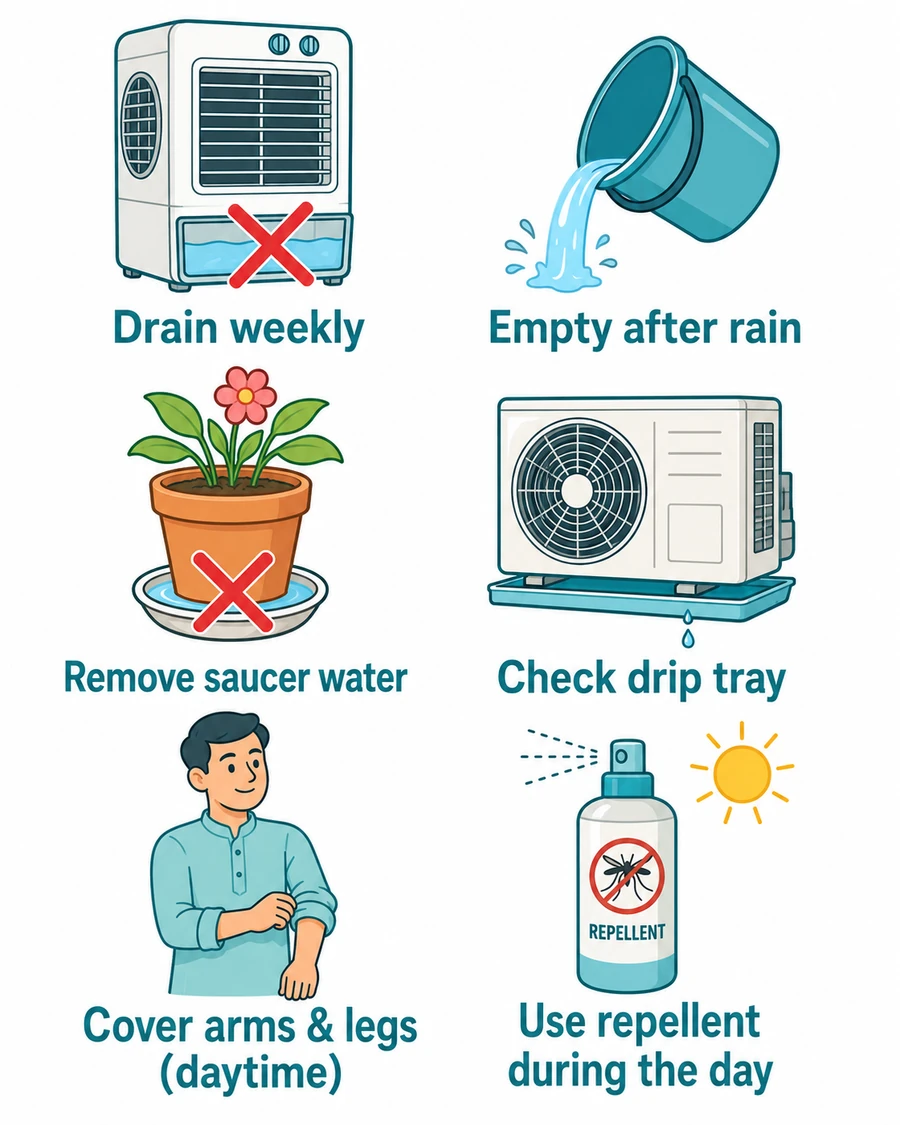
What actually works, on a weekly cadence:
- Empty and scrub every container that holds still water: coolers, terrace tanks, money plant pots, pet water bowls, AC drip trays
- For water bodies that can't be removed: add an oil-based larvicidal solution to break the surface
- Full-sleeve clothing for daytime outdoor exposure
- Repellent on exposed skin during the day. Most people apply it only at night, which is the wrong mosquito.
- Talk to your RWA about building-level weekly source reduction. One household's effort doesn't override a breeding site in the common area.
"Like I tell my father during dengue season: wear a full t-shirt when you go out."
The vaccine question
Patients ask: "Can I just get vaccinated and not worry about this?"
Short answer: not yet, not in India.
"Dengue has four strains. A vaccine against one strain doesn't protect against the other three. And the vaccine can behave like a previous infection — in someone who's never had dengue, that could actually increase the risk of a more severe disease the next time they're infected. That's why making a dengue vaccine has proven so difficult. It's under trial, but it hasn't been made available."
The WHO's current guidance is that any future dengue vaccine should only be given to people confirmed to have had a prior dengue infection — not as blanket immunisation.
For now, the real protection is: prevention (empty those containers), early recognition (don't miss the day-four to day-six window), and correct medication (paracetamol only until a doctor sees you).
If you're concerned about dengue this season, our general clinic in Gurgaon does NS1 and CBC testing through our lab partner, monitors trends, and will refer to hospital if any warning sign appears.
Medical disclaimer: The information on this page is general and educational. It is not specific medical advice for your case. Follow the prescription you were given. If your symptoms change, worsen, or you have questions, contact Dr. Deepika's Complete Family Clinic. Last reviewed by Dr. Deepika Kaushik, May 2026.
Sources & references
- WHO. Dengue and severe dengue (factsheet, 2024).
- WHO + TDR. Dengue: Guidelines for Diagnosis, Treatment, Prevention and Control (2009).
- WHO + TDR. Handbook for Clinical Management of Dengue (2012).
- NCVBDC, GoI. National Guidelines for Clinical Management of Dengue Fever (2015).
- NCVBDC, GoI. Dengue Situation in India — annual surveillance.
- Bhatt S et al. The global distribution and burden of dengue. Nature, 2013.
- Simmons CP et al. Dengue. N Engl J Med, 2012.
- Charan J et al. Efficacy and safety of Carica papaya leaf extract in the dengue. Int J Appl Basic Med Res, 2016.
- Murhekar MV et al. Burden of dengue infection in India, 2017. Lancet Glob Health, 2019.
- Sridhar S et al. Effect of Dengue Serostatus on Dengue Vaccine Safety and Efficacy. N Engl J Med, 2018.
- CDC. Preventing Dengue (updated 2024).
- Wilder-Smith A et al. Dengue. Lancet, 2019 (Seminar).